
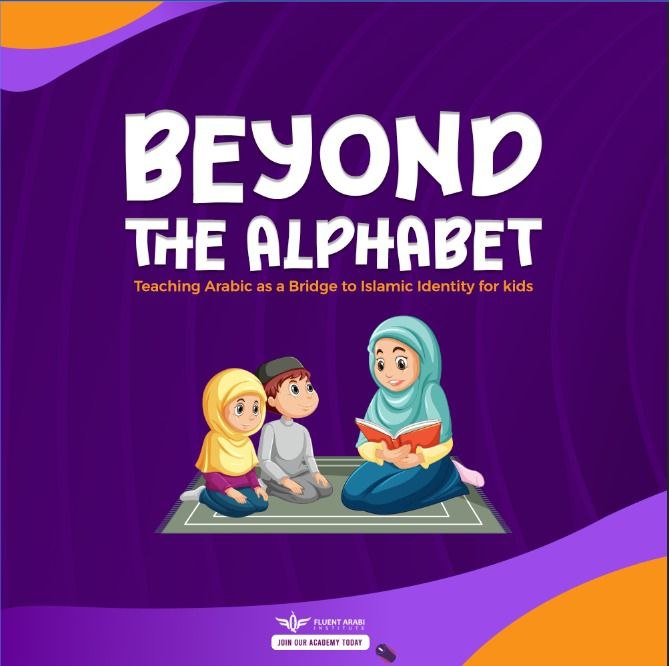
The Arabic language is a precious legacy and a valuable skill that will benefit your kid throughout their life; it is not merely a tool for communication, but the essential key to understanding the Holy Quran and connecting with Islamic identity. Teaching the Arabic alphabet for kids is the first and most fundamental step in this spiritual and academic journey, as it opens the doors to Islamic studies and deepens their connection to their faith.
Through the specialized programs at Fluent Arabi Institute, parents can create an educational environment that blends modern technology with authentic Islamic values, making learning the Arabic alphabet for kids an enjoyable journey that instills a love for the letter “Dhad.”
Why is learning the Arabic alphabet for kids considered the foundation for understanding Islam?
The relationship between the Arabic language and Islamic sciences is one of organic interdependence: the Holy Quran was revealed in clear Arabic and is the foundational source from which all other sciences—such as exegesis, jurisprudence, and the principles of religion—have emerged.
As Sheikh al-Islam Ibn Taymiyyah noted: “The Arabic language is part of the religion, and knowledge of it is an obligatory duty; for the Book and the Sunnah cannot be understood except through it, and whatever is necessary to fulfill an obligation is itself an obligation.
Therefore, parents’ commitment to ensuring their kids master the Arabic alphabet is an investment in their kids’ faith and identity, as these letters serve as the “stepping stones” through which the kids progress toward understanding the will of Allah and the Sunnah of His Prophet (PBUH), thereby fortifying them with a solid foundation for a correct understanding of the religion.
A Practical Roadmap: A Kid’s Journey with the Arabic Alphabet
To ensure your kids’ success in learning the Arabic Alphabet, we must follow a step-by-step strategy that combines digital learning with hands-on activities:
Stage 1: Mental Foundation (Weeks 1–2)
The goal is to create a positive association with the language. Start with interactive viewing through videos and animations that display the letters along with their sounds to break down the fear of complex letters. Use visual associations, such as linking the letter ‘Baa’ to the image of a ‘cow’ (Baqarah), to help solidify the information quickly.
Stage 2: Practice and Training (Weeks 3–4)
“The focus here is on visual discrimination and motor skills, which can be developed using ‘digital tracing’ via smartphone apps. ‘Drag-and-drop’ games are also an excellent way to turn the process of learning the Arabic alphabet for kids into a fun mental challenge, far removed from the rigidity of schoolwork.”
Stage 3: Consolidation and Motivation (Weeks 5–6 and Beyond)
In this stage, we aim to master the varying shapes of the letters. Use interactive letter boards that make a sound when touched, and implement a digital reward system to encourage the kid. Creative coloring of the letters also helps “etch” the letter’s shape permanently into the kid’s visual memory.
The Role of Interactive Technology in Enhancing Language Memory
- In today’s world, technology is no longer merely a means of entertainment; it has become a cornerstone of early childhood education.
- The use of advanced digital platforms directly supports the learning of the Arabic Alphabet for kids.
- When a kid mispronounces or misspells a letter in the app, they receive immediate feedback that encourages them to try again without feeling embarrassed.
- This type of “smart learning” provided by advanced institutions like the Fluent Arabi Institute makes kids better able to grasp the complexities of the Arabic language, which may seem difficult at first, and transforms the learning process from a passive activity into an interactive experience full of excitement and enthusiasm.
Teaching Strategies That Make “Learning” Feel Like “Play”
You should move away from dry, traditional methods and rely on interactive approaches that capture the kids’ attention and make them eager to learn the Arabic alphabet for kids:
- Sensory learning: Use “playdough” to shape letters, or a tray of sand and salt so the kid can trace the letter with their finger. These sensory activities help the kids burn off energy and develop their fine motor skills.
- Auditory learning: The power of songs is unmatched. Kids memorize rhythms much faster than rules, so make songs part of their daily routine to reinforce the sounds of the 28 letters.
- Professional Guidance: The Fluent Arabi Institute remains an ideal choice for parents seeking a structured approach. The institute’s specialized teachers offer a curriculum that takes into account the kids’ psychological characteristics, using educational tools that link language to Islamic values, transforming learning from a burdensome duty into a daily passion.
FAQs
1- What is the ideal age to start learning the Arabic alphabet?
It is recommended to start between the ages of 3 and 5, when a kid’s brain is at its peak in terms of picking up language sounds and memorizing them through play.
2- Why do the shapes of the 28 Arabic alphabet change?
The shapes of the letters change depending on their position (beginning, middle, or end) because Arabic is a cursive language. This variation is the secret to its beauty and the fluidity of its writing, and mastering these shapes is an integral part of reading proficiency.
3- What is the most common mistake when teaching Arabic for kids?
An excessive focus on “rote” memorization and dry writing before the kid has become familiar with the letter and hears it correctly. Always start with play, listening, and visual association before moving on to writing.
Conclusion
The journey of learning the Arabic alphabet is not merely a fleeting educational process, but a strategic investment in the kid’s religious identity and intellectual development. By integrating sensory activities with the modern digital methodologies provided by the Fluent Arabi Institute, we ensure our kids have a strong bridge connecting them to the Holy Quran and the fundamentals of Islamic scholarship. Always remember that gentle repetition, constant encouragement, and a language-friendly environment are the golden keys to your kid’s success in mastering Arabic, so that it becomes the language of their heart and mind throughout their life.
Contact us today to begin this blessed journey.
