
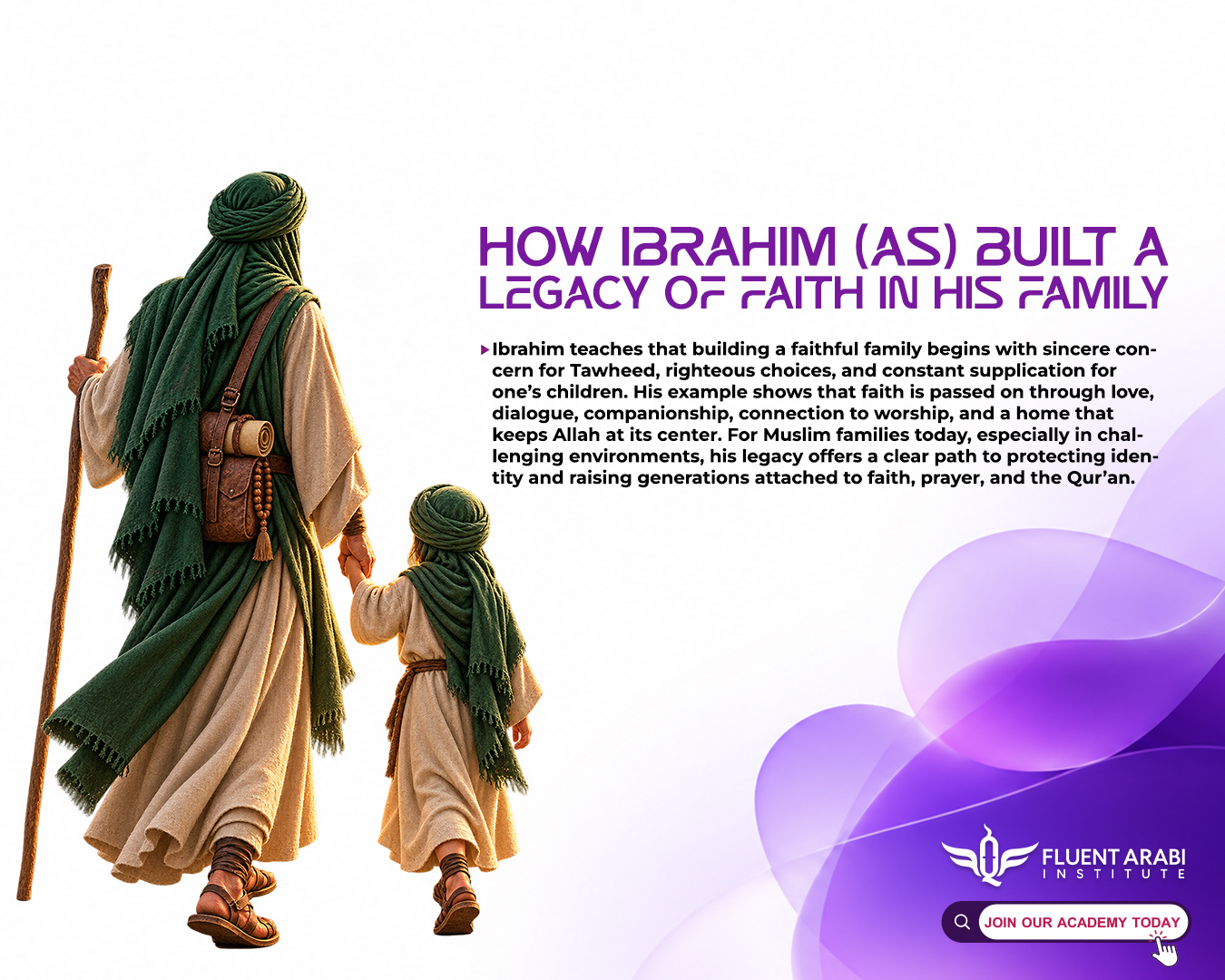
The greatest concern of every Muslim whom Allah has destined to live in the West is the fear that his descendants and children will lose their faith, or that the declaration of monotheism will be severed from his offspring and grandchildren; for this reason, the search for ways to ensure the safety and steadfastness of one’s descendants in the faith is a matter that warrants fear and concern.
The biography of Ibrahim, the Friend of Allah (Khalilullah) and Prophet of Allah (peace be upon him), presents a perfect model for building a legacy of faith that has endured for many generations through his descendants. The Fluent Arabi Institute seeks to shed light for the new generation of Muslims in Western societies on how Ibrahim, through his wisdom and sound judgment, raised a devout family steadfast in obedience to Allah and submission to His command.
How can Muslims in the West build a Legacy of Faith in their families, following in the Footsteps of Ibrahim (peace be upon him)?
1- Pillars of Faith and Family: Choosing a Righteous Mother and Persevering in Prayer
First: Choosing a righteous wife to preserve the faith of one’s offspring)
- The righteousness of one’s offspring begins with choosing a righteous wife; consider what Hajar, peace be upon her, said to her husband when he left her in a barren valley: “Did Allah command you to do this?” He said, “Yes.” She said, “Then He will not forsake us.” She was a wife who placed her trust in Allah, believed in Him, obeyed her husband, and was patient with whatever she faced on her path to Allah. It is only natural that her son would submit to Allah’s will just as she had done before him.
- There is an important message for Muslim youth in the West: they should choose a wife who will help them uphold their religion for their own sake and that of their children, and they should prioritize religious commitment while avoiding marriage to non-Muslims; for choosing a righteous wife is the solid foundation for building a legacy of faith upon which their children will be raised in Western societies.
Second: Persistent supplication for one’s offspring before and after birth
- The concern for the righteousness of his offspring occupied Khalil al-Rahman, peace be upon him, and took up a large portion of his supplications; he never ceased to pray for them and wish them well. And when Ibrahim asked his Lord for offspring, he did not ask merely for a child; rather, he asked Allah for a righteous child; for the righteousness of one’s children is the most important quality a father seeks and hopes for in his children. Among his timeless supplications for the preservation of his children’s faith and their observance of prayer is: “My Lord, make me an establisher of prayer, and [many] from my descendants. Our Lord, and accept my supplication.”
- Supplication is one of the most important factors in ensuring the righteousness of one’s offspring and their adherence to the faith; for constant prayer is the fortress that protects the legacy of faith and ensures its continuity across generations.
2. The Educational and Practical Approach: Love, Dialogue, Connection to the Mosque, and Instilling the Faith
First: Upbringing through love, companionship, and building emotional bonds
- Ibrahim, peace be upon him, showered his son with love and closeness, delved deep into his inner world, and came to understand his personality and way of thinking. This made it easier for him to convey to his son the harshest and most dangerous news that his Lord commanded him to sacrifice him. This emotional bond of love makes it easier for children to respond to parental commands and guidance, no matter how difficult they may be or how much they go against the children’s desires.
- One of the parenting mistakes parents make today, especially in the West, is failing to focus on the importance of emotions and love for their children. Therefore, cultivate a close bond and friendship with your children so that they will confide in you about their innermost thoughts and problems, allowing you to help them resolve them. In this way, you will build a legacy of faith rooted in closeness and affection.
Second: Adopting an approach of dialogue and consultation before issuing orders or resorting to confrontation
- Abraham did not tell his son, “The command has been issued to sacrifice you, and you must comply without hesitation.” Rather, he presented the matter as a consultation, asking for his opinion and leaving the decision up to him: he said, “O my son, indeed I have seen in a dream that I [must] sacrifice you, so see what you think.” This consultative approach to parenting makes it easier for children to comply once we explain the rationale behind the decision.
- It values their opinion and motivates them to act rather than disobey. Today, we are in dire need of dialogue with our children in the West. Ishmael’s response was one of submission: “He said, ‘O my father, do as you are commanded; you will find me, if Allah wills, of the steadfast.”
Third: Connecting Children to Mosques and Instilling Religious Commitment Until Death
- The Prophet Abraham (peace be upon him) did not go to the mosque alone or pray by himself without his son; rather, he involved him in righteous deeds and in the construction of the Sacred House: “And [mention] when Abraham was raising the foundations of the House and [with him] Ishmael, [saying], ‘Our Lord, accept [this] from us. Indeed, You are the Hearing, the Knowing.’” Taking children to mosques in the West is one of the most important educational duties for strengthening their commitment to the faith.
- His love and concern for his descendants never wavered; when Allah chose him and said, “I will certainly make you into a role model for the people,” Abraham asked, “What about my offspring?” (Quran 2:124). Concern for his offspring’s faith and proper religious practice remained a constant preoccupation for Abraham, peace be upon him, even in the final moments of his life: “And Abraham instructed his sons [to do the same] and [so did] Jacob, [saying], ‘O my sons, indeed Allah has chosen for you this religion, so do not die except while you are Muslims’” (Quran 2:132), thereby establishing an enduring legacy of faith.
FAQs
1- How can a Muslim begin to build a legacy of faith within his family in the West?
This begins with carefully choosing a righteous wife who places her trust in Allah, consistently praying for one’s children to be righteous and to uphold the Oneness of Allah before their birth, during their childhood, and as they grow older, and devoting worship solely to Allah while seeking sustenance from Him alone.
2- What is the benefit of using dialogue and consultation with children, as illustrated by the story of Abraham and Ishmael?
Dialogue and consultation are educational approaches that facilitate children’s compliance with Islamic commands and guidance after explaining the rationale behind decisions. This approach values their opinions, motivates them to act, and helps avoid conflict and disobedience.
3- How can we help our children remain steadfast and consistent in their prayers in the West?
This is achieved by constantly praying for them to establish prayer, just as Ibrahim used to supplicate: “My Lord, make me an establisher of prayer, and [many] from my descendants. Our Lord, and accept my supplication,” and by surrounding them with love and companionship to support them, as well as taking them to mosques and attending congregational and group prayers to strengthen their commitment to obedience.
Conclusion
The biography of the Prophet of Allah, Abraham, peace be upon him, which the Fluent Arabi Institute’s programs emphasize, shows us that leaving a legacy of faith requires sincere trust in Allah, the wise choice of a righteous wife, and constant supplication both before and after childbirth, while showering one’s offspring with love, companionship, and calm dialogue, and guiding them to the mosques.
The righteousness of one’s offspring is a great aspiration and a constant concern that does not end until a person leaves this life. Because of Prophet Ibrahim’s (peace be upon him) constant supplication and unwavering devotion, Allah honored him and brought joy to his heart through his offspring; He made all the prophets who came after him from his lineage. Indeed, the noblest of messengers were from his lineage and the fruit of his supplication. How eagerly we should follow in Abraham’s footsteps (peace be upon him) and be guided by his example!
