
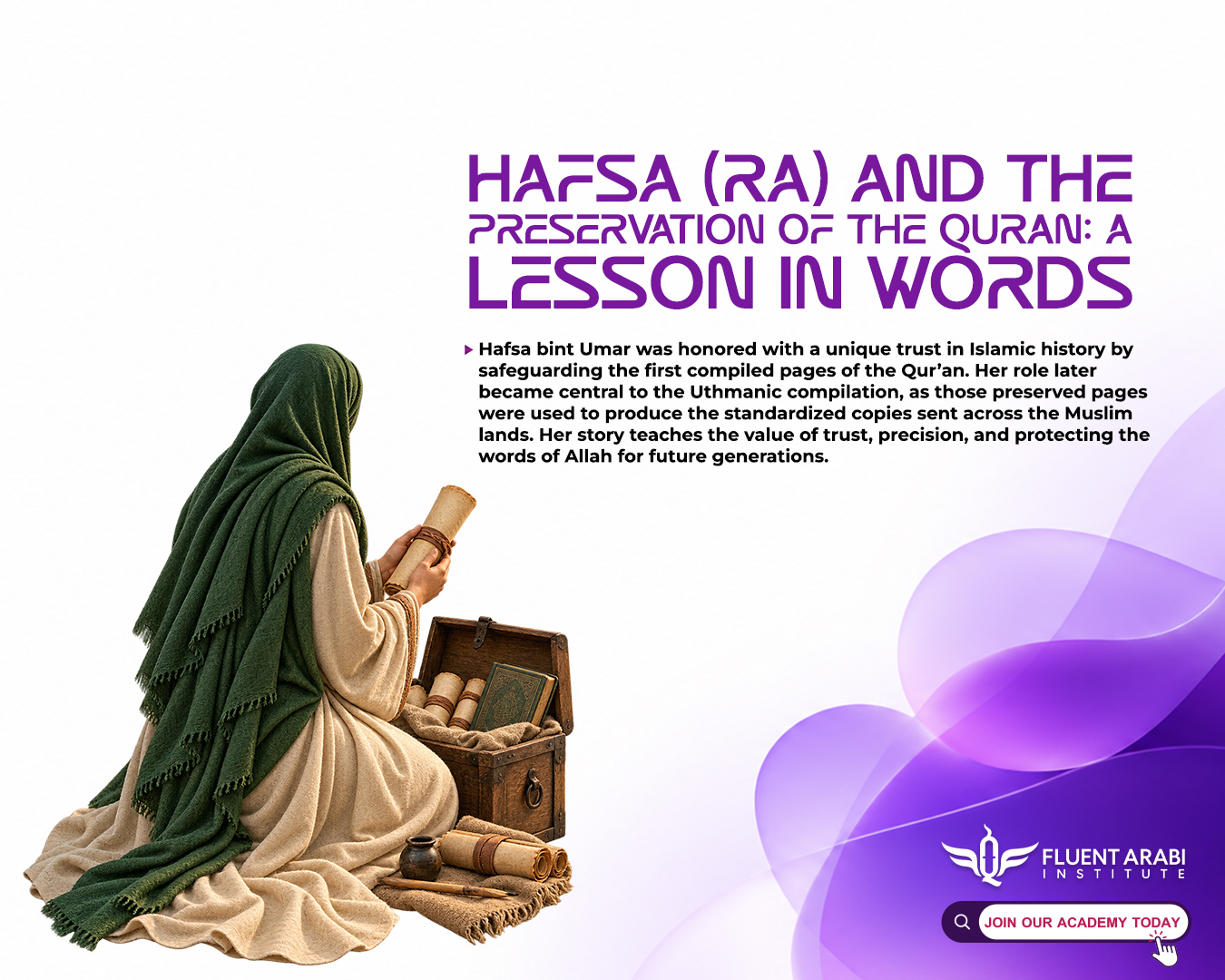
The Preservation of the Quran and documenting it with precision are considered one of the most important pillars that have preserved this religion and its language throughout the ages, a value that the Fluent Arabi Institute seeks to instill in Muslim youth and communities in the West.
Understanding how this noble text has reached us with the utmost precision instills in new generations the value of scholarly integrity and linguistic accuracy. The biography of Hafsa, Mother of the Believers and Guardian of the Holy Quran, represents the most prominent and exalted example of how the Quranic text has been preserved and meticulously transcribed throughout history.
The Role of the Companions and Hafsa (RA) in the Preservation of the Quran
1. Umm al-Mu’minin Hafsa, may Allah be pleased with her (Guardian of the Quran)
- Her Lineage and Upbringing: She was Hafsa bint ‘Umar ibn al-Khattab, and her brother was ‘Abdullah ibn ‘Umar. She was born five years before the Prophet’s (PBUH) mission, during the time when the Quraysh were building the Ka’bah.
- Her First Marriage: She married Khunays ibn Hudhafa al-Sahmi and migrated with him to Abyssinia and Medina. He fought at the Battle of Badr and died from his wounds at the Battle of Uhud.
- Her Marriage to the Prophet (PBUH): Umar proposed her to Uthman and then to Abu Bakr, but neither accepted. The Prophet (PBUH) then proposed to her in the third year of the Hijrah.
- Her Status and Virtues: Gabriel, peace be upon him, descended to commend her, saying: “She fasts and is steadfast, and she is your wife in Paradise.” She was nicknamed “The Guardian of the Quran” for her role in preserving the first handwritten copy of the Quran. The story of Hafsa, the Guardian of the Holy Quran, is a great source of pride for the role of Muslim women in preserving Islamic law and transmitting knowledge.
- Her Death: She devoted her life to worship, fasting, and night prayers until she passed away during the reign of Mu’awiya ibn Abi Sufyan, may Allah be pleased with him.
2. The Preservation of the Quran During the Prophetic Era
- The Gradual Revelation of the Quran: It was revealed in separate parts and in a measured, rhythmic manner over a period of 23 years according to divine decree; this served to strengthen the Prophet’s (PBUH) heart and ensure the gradual introduction of legislation.
- Method of Recording and Arrangement: The Prophet (PBUH) had scribes to whom he dictated the verses and specified their placement within the surahs under the guidance of Jibril, peace be upon him.
- Available Writing Materials: The Quran was written in scattered form on palm fronds, thin stones, animal bones, leather, and pieces of cloth.
Reasons for not compiling the Quran into a single mushaf during the Prophet’s lifetime:
- Anticipation of further revelations or the abrogation of certain verses throughout the Prophet’s (PBUH) lifetime.
- To avoid the difficulty of rearranging the Quran whenever a new verse is revealed.
- The widespread memorization and preservation of the Quran by the Companions ensured its safety from distortion or loss.
Evidence of the Quran’s written form during the Prophetic era:
- From the Quran: The disbelievers accused the Prophet (PBUH) of writing “the tales of the ancients” and having them dictated to him.
- From the Sunnah: The Prophet (PBUH) forbade writing anything about him other than the Quran to prevent confusion, and he forbade traveling with the Mushaf to enemy territory for fear of its sanctity being violated; these are documentary evidence that highlights the role of Umm al-Mu’minin Hafsa, the later guardian of the Noble Quran, in preserving this written record.
3. Stages of Compilation and the Preservation of the Quran During the Era of the Companions (The Role of the Manuscripts and Hafsa’s Mushaf)
The First Compilation (the era of Abu Bakr al-Siddiq, may Allah be pleased with him):
- Reason: The martyrdom of a large number of Quran reciters in the Battle of Yamama and Umar ibn al-Khattab’s fear that the Quran might be lost.
- Implementation: Abu Bakr tasked the Companion Zayd ibn Thabit with compiling the Quran from palm-leaf scrolls, parchment, and the memories of the men after meticulous verification.
- The Historical Journey of the Manuscripts: The first manuscripts were kept by Abu Bakr, then passed to Umar ibn al-Khattab, and finally entrusted to Lady Hafsa, the Guardian of the Holy Quran, for safekeeping and preservation.
The Second Compilation (during the reign of Uthman ibn Affan, may Allah be pleased with him, and the role of Umm al-Mu’minin Hafsa):
- Reason: Disagreements arose among Muslims regarding recitations during the conquests of Armenia and Azerbaijan, and Hudhayfah ibn al-Yaman proposed unifying the copies of the Quran.
- The pivotal role of Hafsa: Uthman sent for Umm al-Mu’minin Hafsa, the guardian of the Holy Quran, to retrieve the original scrolls entrusted to her for The Preservation of the Quran, so they could be transcribed and returned to her.
- Standardization of the Quran: Uthman ordered a committee headed by Zayd ibn Thabit to transcribe the pages in the Quraysh dialect, send a copy to every region, and burn all other versions to unify the Muslim community.
FAQS
1- Why is the Mother of the Believers known as “Hafsa, the Guardian of the Holy Quran”?
Because she was chosen from among all the Mothers of the Believers and the Companions to be entrusted with preserving the first written and compiled copy of the Holy Quran after the deaths of Abu Bakr and ‘Umar, may Allah be pleased with them both.
2- What role did the scrolls entrusted to Hafsa play in the Uthmanic compilation?
The manuscripts entrusted to Hafsa, the guardian of the Holy Quran, served as the core and primary source upon which Caliph Uthman ibn Affan relied to produce the official, standardized copies of the Quran, distribute them to the provinces, and then return the original manuscripts to her.
3- How can a Muslim in the West benefit from studying the history of the compilation of the Quran?
They learn the importance of integrity in transmitting texts and come to appreciate the greatness of Islamic history in terms of scholarly and linguistic documentation, which strengthens their confidence in and pride in their identity and the Arabic language.
Conclusion
This precise historical account of the preservation of the Quran demonstrates the integrity and effort expended to preserve the sacred text.
The Fluent Arabi Institute aims, through presenting the biography of Hafsa, the Guardian of the Holy Quran, to instill in the hearts of our children and students the values of accuracy, linguistic precision, and the preservation of texts, so that they may follow the example of the noble Companions and the Mothers of the Believers in protecting the Book of Allah and caring for the Arabic language.
Ready to deepen your connection with the Quran and master the Arabic language?
Join our specialized courses at Fluent Arabi Institute today and start your journey of learning with expert native instructors!
