
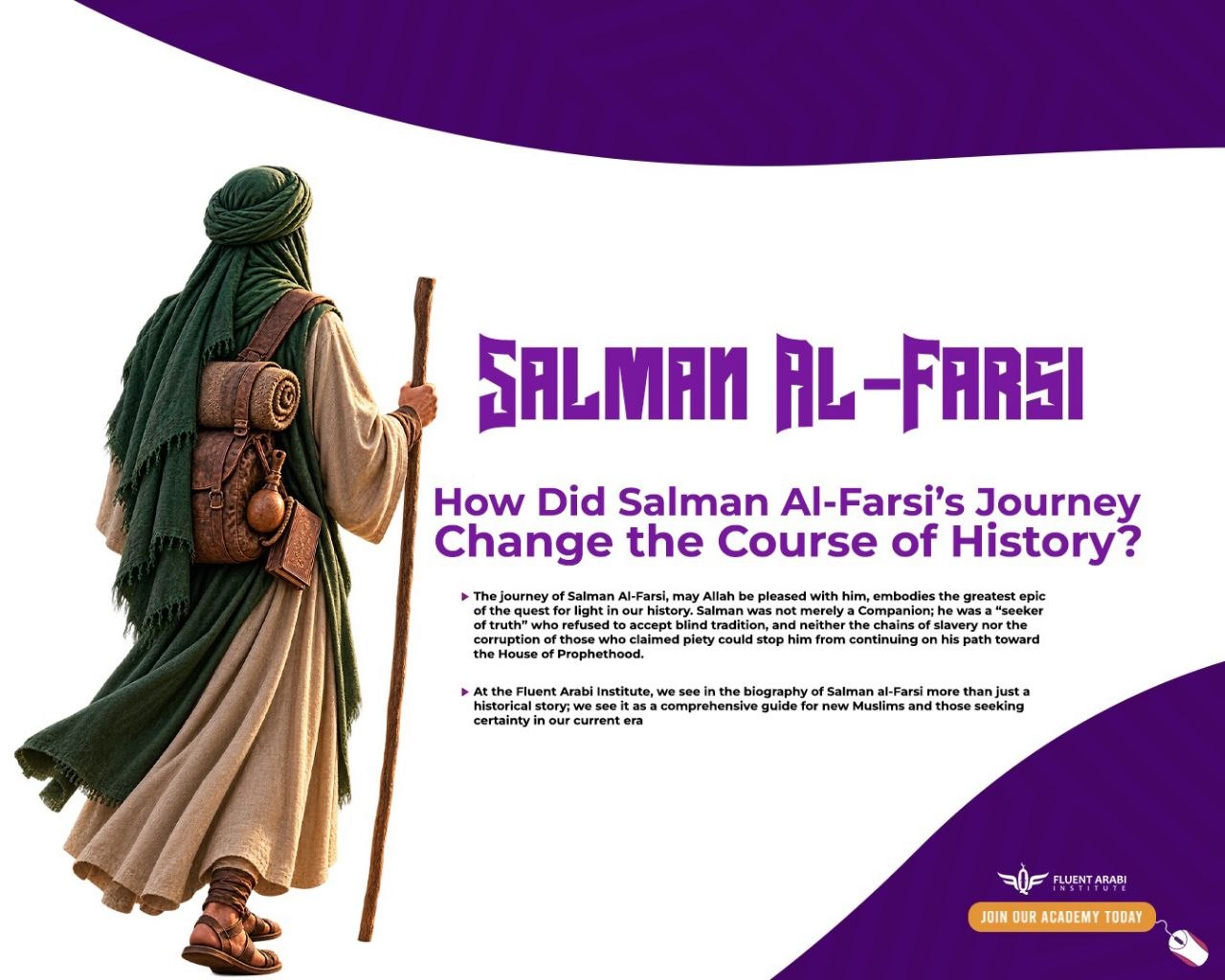
In the history of Islam, we rarely find a figure who embodied the “search for truth” with all its sincerity, pain, and radiance as this venerable Companion did. At the Fluent Arabi Institute, we believe that the biographies of great figures serve as a bridge leading us toward a deeper understanding of human and religious values.
The journey of Salman al-Farsi is not merely a recounting of historical events, but rather a study in the philosophy of certainty, the very philosophy that led Ibn al-Qayyim, in his work Al-Fawaid, to pause in contemplation before the greatness of this man who attained faith through suffering rather than by inheritance, thus becoming a symbol for all who seek the light amidst the darkness of confusion.
How Does Salman al-Farsi’s Journey Guide New Muslims?
First: Breaking Free from the Shackles of Tradition in the Journey of Salman al-Farsi
- The Journey of Salman al-Farsi, may Allah be pleased with him, embodies the hallmarks of the quest for truth, a journey that began in the “Golden Prison.”
- Salman was born into absolute luxury; his father was the leader of the village of “Jayan” in Isfahan and the wealthiest of its people, to the point that he feared even a breath of air might harm his son and kept him locked in the house for fear that he might lose his Zoroastrian faith.
A Thought-Provoking Moment
Imagine the magnitude of the psychological conflict faced by a young man living within the walls of palaces while his soul wandered toward other horizons.
- But this bliss did not seduce him; rather, he was the first to rebel against that “golden prison,” choosing to escape secretly with the caravans, defying the shackles on his feet, to begin a spiritual struggle that transcended the boundaries of race and class.
- Salman the Persian’s journey teaches us that true allegiance is to the truth, not to a tribe or social heritage.
- Salman faced immense pressure, yet he never looked back; his first lesson for us is that whoever seeks Allah must free his will from the constraints of his surroundings and environment.
Second: At the House of Prophethood… Milestones in Salman Al-Farsi’s Journey
- Salman Al-Farsi’s journey is his “discernment” in the pursuit of knowledge. He was neither a naive seeker nor a blind follower; rather, he scrutinized the integrity of every teacher he encountered.
- When he discovered the corruption of the first bishop, who was embezzling charity funds for himself, he did not lose hope in religion, but continued his journey, traveling from Mosul to Nisibis and Amoria, patiently enduring his exile, until the last of them guided him to the Seal of the Prophets, who accepts gifts but does not consume charity.
- This transformation from a Zoroastrian who worshipped fire to a Companion of whom it is said, “Salman is one of the People of the House,” represents the highest degree of spiritual elevation in Salman the Persian’s journey.
- Salman learned that what matters is not names or titles, but the sincerity of one’s path.
- Upon meeting the Prophet (PBUH) in Yathrib, that sense of alienation gave way to stability within the embrace of revelation, and he became the “Wise One of the Ummah,” who weighs every word on the scales of wisdom.
- In this context, we recall his pioneering effort in explaining the meanings of Surah Al-Fatiha in Persian for his people to facilitate their worship.
- This laid the early groundwork for introducing non-Arabs to the essence of the Quranic message with wisdom and clarity.
Third: The Balance of Harmony and Justice in Salman al-Farsi’s Journey
- Salman’s life, with all its setbacks and triumphs, remains a beacon for every contemporary seeking spiritual conviction amid the clamor of ideas.
- Salman’s asceticism was not isolation; rather, it was a delicate balance between spirit and body, which becomes clear when we examine it through The Journey of Salman al-Farsi; he was a voice for the truth who feared none but Allah, the Exalted.
- The story of how he corrected Abu al-Darda’s understanding of worship when he said to him, “Your Lord has a right over you, you have a right over yourself, and your family has a right over you,” is a guiding principle for every Muslim who seeks to adhere to the faith without excess or negligence.
- Salman also refused to allow authority during his reign as governor of Al-Madain to become a means of luxury; instead, he earned his living through manual labor, demonstrating to the world that leadership in Islam is a service, not a source of prestige.
- This balance is the essence of Salman Al-Farsi’s journey, in which he viewed asceticism not as possessing little, but as not being possessed by what little one has, and as being a servant to one’s people rather than their master.
Fourth: The Good News and the Lasting Impact of Salman Al-Farsi’s Journey
- In moments of despair while digging the trench, Salman was a beacon of hope when the Prophet (PBUH) foretold the conquest of Persia and Rome, so that the prophecy would be fulfilled and the land of the Persians would become a beacon of knowledge.
- Salman al-Farsi’s journey served as the “spiritual forefather” of the non-Arab scholars of the Ummah and as the bridge across which the values of Islam crossed to embrace the diversity of the world.
- He was also a symbol of cultural openness, combining his prior knowledge of other religions with the light of revelation to become one of the earliest companions to bridge the language barrier by conveying the meanings of revelation to non-Arabic speakers.
- This journey affirms that whoever is sincere in their quest for Allah, Allah will open the doors of guidance for them.
Fifth: Lessons from the Journey of Salman al-Farsi. A Compass for Seekers of Truth in Our Time
The significance of Salman al-Farsi’s journey is not limited to historical narrative; rather, it serves as an educational model relevant to every era. At the Fluent Arabi Institute, drawing on our educational experience, we must reflect on the lessons of his journey:
- Sincerity and Determination: Salman did not rely on his heritage; rather, he devoted everything he had to his journey in search of the truth, proving that a sincere quest is never in vain.
- Faith Based on Conviction: Salman rejected “blind acceptance,” making Salman al-Farsi’s journey a model for the modern Muslim who builds his faith on knowledge, not assumptions.
- The Wisdom of Discernment: Taking one’s time in choosing a teacher is the essence of what we have learned from his biography.
- Separating the Truth from People’s Mistakes: Always remember that “people” make mistakes; do not let disappointments cause you to stray from the path of Allah.
Sixth: Contemporary Challenges Reflected in the Journey
In light of the challenges faced by new Muslims today, we find great solace in Salman’s life. He experienced the feeling of being an “outsider” everywhere—from his homeland to Syria and then to Medina. This sense of alienation is what many suffer from today, but Salman taught us how to transform this alienation into a fruitful “journey of discovery.” He faced bullying, slavery, and persecution, yet his heart remained steadfast in the truth. Our deep understanding of Salman al-Farsi’s journey helps us realize that Allah does not let the reward of the patient go to waste, and that faith is not a comfortable deal, but rather a long path that requires patience, certainty, and perseverance.
FAQs
Based on our experience at the Fluent Arabi Institute, new Muslims and seekers of truth often ask questions about this great figure. Here are the most notable ones:
1- Why is Salman al-Farsi considered an ideal role model for new Muslims in the modern era?
Because his experience is not limited by time or place; he represents someone who came from a cultural background completely different from Islam and, thanks to his sincere search and open mind, was able to reach the essence of the truth. He gives every seeker of truth the confidence that the path to guidance is open to those who are sincere in their quest, regardless of their roots or cultural background.
2- How can we benefit from the “art of discernment” that characterized Salman, given the abundance of sources today?
Salman al-Farsi’s journey taught us that discernment means “critical scrutiny”. In an age where information is available to everyone, many are bewildered by contradictions. Salman taught us that a sincere teacher connects you to Allah, not to himself, and whose words and deeds are consistent. Discernment is a tool for filtering influencers and teachers, where you seek spiritual impact and practical sincerity before being drawn to appearances or numbers.
Conclusion
As death approached, Salman wept—not out of fear of death itself, but out of fear that he might have gathered from the world’s debris what would weigh down the traveler’s burden. With his immortal words, “The earth sanctifies no one,” he summed up his journey; for sanctity lies in deeds and piety, not in place or time. Salman al-Farsi’s journey served as a roadmap for every seeker of truth, affirming that Allah chooses whom He wills, and that whoever is sincere in their search for the light will ultimately find themselves at the heart of the “House of Prophethood,” to become a model of asceticism and a testament to certainty.
Therefore, the Fluent Arabi Institute invites you to draw inspiration from these lessons on your journey of knowledge, so that you may become an extension of the light that illuminated Salman’s heart centuries ago.
