
The miracles of the Qur’anic text are evident in its unique ability to penetrate the hearts of those who understand the secrets of language and the masters of eloquence; thus, the guidance of the noble Companions was not merely a passing conviction, but rather a response to the call of the Truth, which captivated the minds with its clarity. Fluent Arabi Institute is committed to instilling rhetorical appreciation and Qur’anic understanding in its educational programs.
The story of Abu Dharr al-Ghifari’s conversion to Islam is one of the most remarkable examples of guidance rooted in pure human nature and keen linguistic insight. He, may Allah be pleased with him, was a burly, deeply tanned man whose innate nature had not been tainted by idol worship. When the light of Islam dawned in Mecca, he embarked on a sincere journey of discovery that led him from examining the weight of words [poetic meters] and the eloquence of the text to proclaiming the Oneness of Allah, transforming him from a man seeking the truth into a believer calling others to it.
Abu Dharr al-Ghifari’s Conversion to Islam and the Journey from Monotheism to Truth
Abu Dharr al-Ghifari’s Conversion to Islam – Monotheism Amid the Age of Ignorance
Through a sincere journey of discovery and a soul eager for the truth, Abu Dharr, may Allah be pleased with him, was distinguished by a pure nature that rejected the ways of the pre-Islamic era; hence, he refrained from idol worship and renounced its rituals. He prayed to Allah Almighty for three full years before meeting the Prophet (PBUH); he would go wherever his Lord guided him. When news of the new Prophet in Mecca reached his ears, his soul was moved to verify and seek out the source of this light of monotheism.
2. Abu Dharr al-Ghifari’s Conversion to Islam and Anis’s Testimony on the Eloquence of the Message
Abu Dharr al-Ghifari (Jundub ibn Junada) sent his brother Anis, a renowned poet well-versed in poetic meters who had once challenged another poet to a poetic contest and defeated him, to inquire about the Messenger (PBUH). Anis returned with conclusive testimony that astonished him, confirming that he had listened to the soothsayers, compared the Prophet’s words to all poetic meters, and found that they resembled neither poetry nor fortune-telling. Instead, they were eloquent speech commanding noble character and calling unto Allah. This linguistic testimony was the first key milestone leading to Abu Dharr al-Ghifari’s conversion to Islam, making him realize that this composition transcended human capabilities.
3. The Journey to Mecca for Abu Dharr al-Ghifari’s Conversion to Islam and Hiding in the Grand Mosque
Abu Dharr set out for Mecca in secret, hiding from the oppression of Quraysh to pursue Abu Dharr al-Ghifari’s conversion to Islam. He stayed at the Sacred Mosque for several days without knowing the Prophet (PBUH), reluctant to ask anyone. Eventually, weakened by hunger, he asked a local man about him. The man shouted, “He is a Sabian!” and the people of the valley turned upon Abu Dharr with stones and bones, beating him until he collapsed unconscious.
When he stood up, he looked like a red idol drenched in blood. Shortly after, Imam Ali ibn Abi Talib, may Allah be pleased with him, noticed him, recognized he was a stranger, and hosted him for three days without asking why he had come, a unique model of noble hospitality and tactful discretion.
4. A Miracle of Sustenance Behind the Curtains of the Kaaba During Abu Dharr al-Ghifari’s Conversion to Islam
During his thirty-day stay in Mecca, day and night, between the Kaaba and its curtains, Abu Dharr had no food or drink except Zamzam water, until he grew plump and his belly folds increased, without feeling any weakness from hunger or emaciation. The Prophet (PBUH) acknowledged this miracle of faith when he met him later, saying: “It is blessed; it is nourishing food,” making Zamzam both sustenance and strength for him on his journey in search of the truth.
Key Milestones and Lessons from Abu Dharr al-Ghifari’s Conversion to Islam
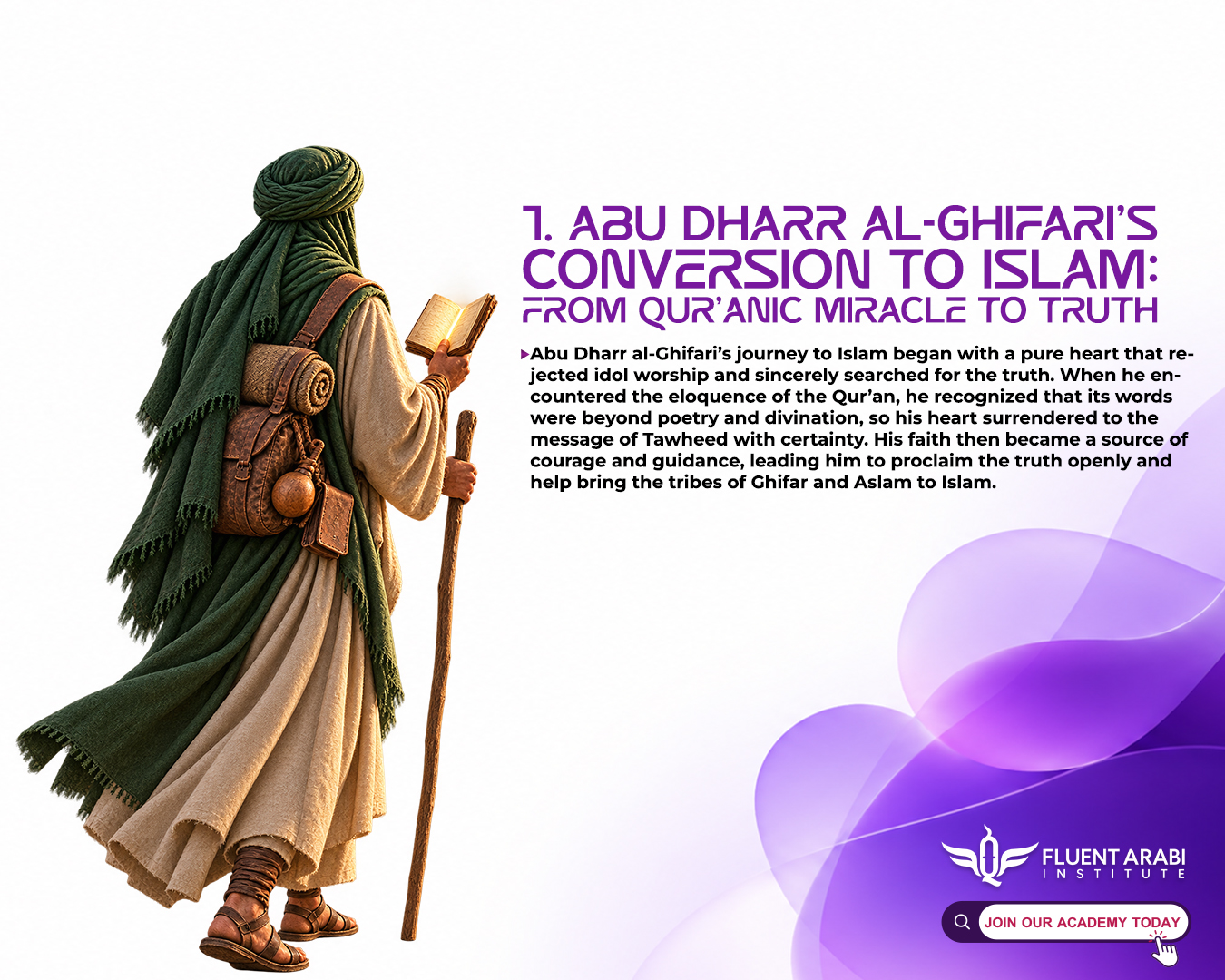
1. The Magic of the Qur’an’s Eloquence and the Moment of Abu Dharr al-Ghifari’s Conversion to Islam
“On the third day, Imam Ali, may Allah be pleased with him, brought him to the presence of the Messenger of Allah (PBUH). When Abu Dharr heard the verses of the Wise Reminder, the eloquence of the Qur’an captivated his heart and mind, and all traces of doubt crumbled before the power of its message.
The moment of Abu Dharr al-Ghifari’s conversion to Islam was fulfilled at that very instance, as he studied the Qur’an and the rulings of the religion, had the honor of being the first to greet the Messenger (PBUH) with the eternal Islamic greeting (“Peace be upon you, O Messenger of Allah”), and Abu Bakr al-Siddiq, may Allah be pleased with him, hosted him and fed him raisins from Ta’if.”
2. Abu Dharr al-Ghifari’s Conversion to Islam and the Balance Between Faith and Proclamation
Although the Prophet (PBUH) granted Abu Dharr the concession to conceal the message, saying to him, out of fear for his safety from the Quraysh, his innate courage drove him to choose “resolve”. He went out to the courtyard of the Kaaba. He shouted at the top of his lungs the testimony of monotheism, so the Quraysh rose against him and beat him until they nearly killed him.
Still, Al-Abbas ibn Abd al-Muttalib, may Allah be pleased with him, saved him by reminding them that their trade route to Syria passed through his tribe, the Ghifar. Nevertheless, Abu Dharr repeated the truth the following day with rare steadfastness.
3. The Blessing of an Individual’s Faith Over the Community and the Guidance of Ghifar
Abu Dharr returned to his people with a prophetic command. He began with his own household, and his mother and brother converted to Islam. Then he called upon his tribe, and half of the Ghifar converted immediately under the leadership of their chief, Ima’a ibn Rahda, while the other half converted upon the Prophet’s (PBUH) arrival in Medina. When the tribe of Aslam arrived with them, they all pledged allegiance.
Hence, the Prophet (PBUH) invoked upon them an eternal prayer, so that the impact of Abu Dharr al-Ghifari’s conversion to Islam might be evident in the guidance of an entire nation.
4. The Seven Characteristics of Abu Dharr al-Ghifari’s conversion to Islam
The Messenger advised him to adopt seven comprehensive qualities: love for the poor and drawing close to them, looking out for those less fortunate than oneself, maintaining family ties, refraining from begging, speaking the truth even if it is bitter, not fearing the reproach of others for the sake of Allah, and frequently saying, “There is no power and no strength except with Allah” (لا حول ولا قوة إلا بالله).
5. Purity at the End of Life and a Modest Estate Following Abu Dharr al-Ghifari’s Conversion to Islam
Abu Dharr stipulated that no one who held a governorship or a post of authority should shroud him, so a young Ansari man shrouded him in two garments spun by his mother, and the venerable Companion ‘Abdullah ibn Mas’ud, may Allah be pleased with him, led the funeral prayer for him along with a group of believers.
He died in the year 31 or 32 AH during the caliphate of ‘Uthman ibn ‘Affan, may Allah be pleased with him, leaving behind nothing of this world but two donkeys, a mule, and some riding gear, thus setting the most magnificent example that Abu Dharr al-Ghifari’s conversion to Islam marked the beginning of a journey of absolute sincerity and pure asceticism.
FAQs
1- How did the rhetorical style of the Quran help Abu Dharr discover the truth of Islam?
Abu Dharr listened to the Qur’an with a mind attuned to its mysteries, and through the experience of his brother Anis al-Sha’ri and his own listening, he realized that the power of the Qur’anic verse surpasses all poetic meters and styles of divination, which became the core reason behind Abu Dharr al-Ghifari’s conversion to Islam and convinced him that it was divine revelation.
2- What was the first greeting Abu Dharr used when greeting the Prophet (PBUH)?
Abu Dharr al-Ghifari, may Allah be pleased with him, was the first to greet the Prophet (PBUH) with the Islamic greeting; as soon as he met him in Mecca, he said to him, “Peace be upon you, O Messenger of Allah.”
3- How did Abu Dharr al-Ghifari’s Conversion to Islam affect his tribe, the Ghifar, and the Aslam tribe?
Abu Dharr began by inviting his family to Islam, and they converted. He then invited his tribe, and half of them converted immediately, while the rest converted upon the Hijrah. They followed the tribe of Aslam, and all of them received the Prophet’s (PBUH) supplication for guidance and safety.
Conclusion
The biography of Abu Dharr al-Ghifari, may Allah be pleased with him, remains a living testament to the fact that a pure natural disposition and deep contemplation of the eloquence of the Qur’an are the shortest paths to knowing the truth and reaching Allah. His story of conversion to Islam exemplifies the meanings of absolute sincerity, the courage to speak the truth openly, and pure detachment from the transient pleasures of this world.
The lesson of Abu Dharr is not limited to how he personally found guidance; rather, it extends to teach us how the sincerity of a single individual can change the course of history for entire tribes, and that when the sweetness of faith enters the heart, it instills a steadfastness unshaken by trials and a certainty that rises above the temptations of life, which is the noble meaning that Fluent Arabi Institute seeks to establish and spread.
