
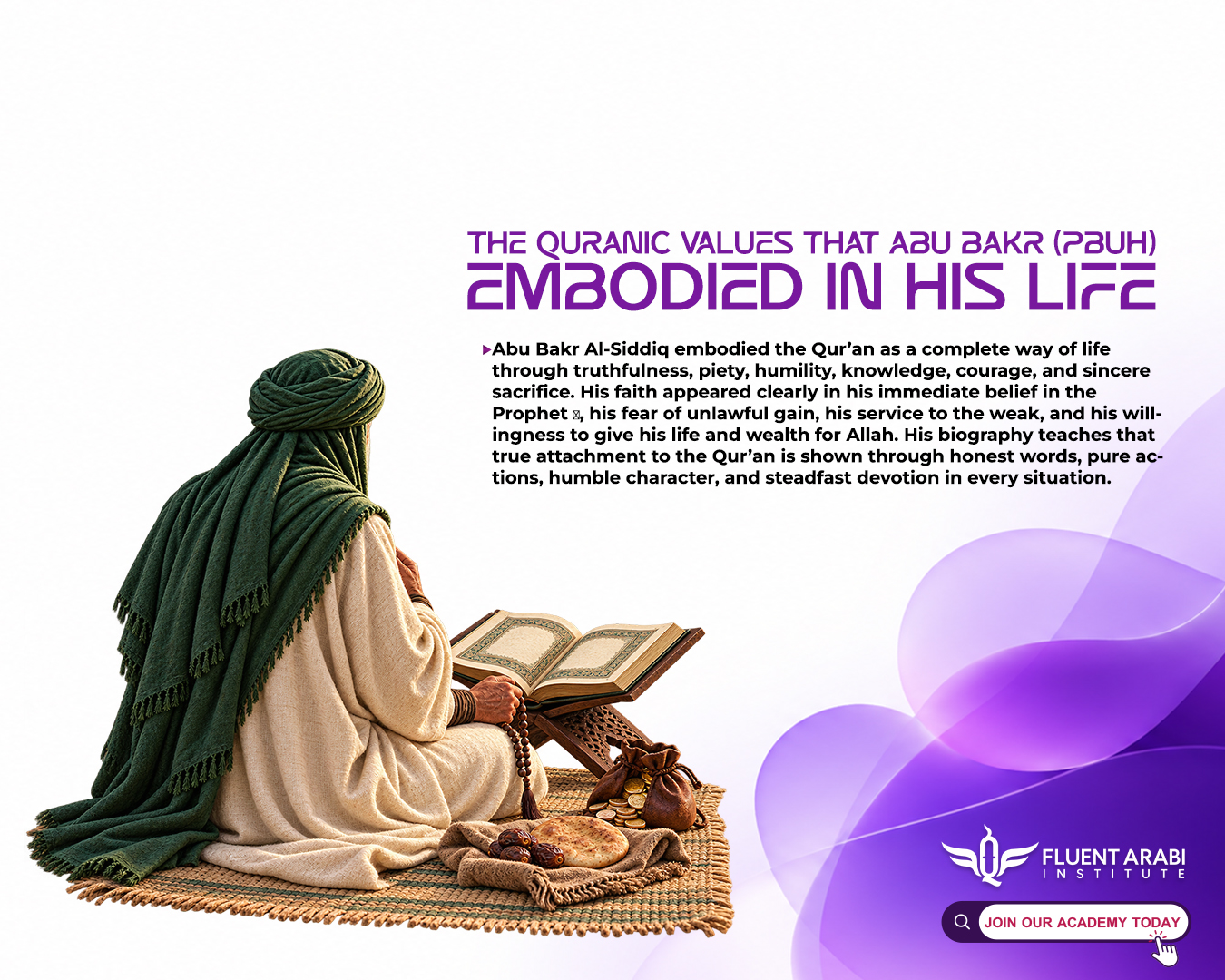
For the Companions of the Messenger of Allah (PBUH), the Holy Qur’an was not merely a set of recited letters; it was a comprehensive way of life embodied in their behavior and a moral compass reflected in their daily interactions. At the forefront of this nation, the values of Abu Bakr stand out as the supreme practical implementation of the guidance found in the Noble Book. May Allah be pleased with him, he integrated purity of faith, perfection of character, profound knowledge, deep piety, and absolute sacrifice.
Abu Bakr’s spiritual standing did not arise by chance; it was the direct outcome of his total submission to divine revelation. He became a unique role model, demonstrating how the Qur’an shapes a man whose faith outweighs the faith of the entire nation combined. In this article, endorsed by Fluent Arabi Institute, we explore the details of his noble biography to understand the primary values Abu Bakr embodied and how he lived them in word and deed, providing a guiding beacon for every Muslim striving to apply the Book of Allah in modern life.
Key Quranic Pillars in the Life of Abu Bakr
First: The Value of Truthfulness and Its Qur’anic Dimensions in Al-Siddiq’s Life
The value of truthfulness ranks foremost among Abu Bakr’s virtues. In Islam, truthfulness is the essential driving force behind both outward and inward integrity; it is the precise criterion that distinguishes the believer from the hypocrite, and the inhabitants of Paradise from the dwellers of Hellfire.
1. The Concept and Importance of Truthfulness
- Definition: Truthfulness is the opposite of lying; it means stating a matter exactly as it is.
- Significance: Truthfulness is the sword of Allah on Earth—whatever it strikes, it severs, and whatever falsehood it confronts, it completely overthrows and defeats.
2. Dimensions of Truthfulness in Al-Siddiq’s Life
- Truthfulness with Allah: Sincerity of intention, complete submission, obedience, and total alignment between one’s private thoughts and public actions, free from any ostentation.
- Truthfulness in Speech: Guarding the tongue to speak only truth and rightness, verifying news before transmission, and maintaining fairness in testimonies and character references.
- Truthfulness in Action: Aligning knowledge with sacred law, executing duties with excellence, and fulfilling rights completely without fraud or deception.
- Truthfulness with Creation: Committing to the truth in commerce, general dealings, and promises. Truthfulness is a social necessity that ensures societal cohesion and stability. For this reason, the Prophet (PBUH) warned against lying even to children to prevent instilling this blameworthy trait in their hearts.
3. Reason for the Title “Al-Siddiq”
Abu Bakr was bestowed with the title “Al-Siddiq” (The Truthful / The Firm Believer) due to his absolute precedence in believing the Prophet (PBUH).
During the incident of Al-Isra’ and Al-Mi’raj (The Night Journey and Ascension), when the polytheists rejected the Prophet’s account and approached Abu Bakr, claiming that Muhammad (PBUH) asserted he traveled to Jerusalem and returned before dawn, Abu Bakr replied with unshakeable conviction: “Did he say that?” They replied, “Yes.” He said: “If he said so, then he has spoken the truth! I believe him in matters far beyond that; I believe him regarding news from the heavens in the morning or evening.”
4. The Fruits and Impacts of Truthfulness
- It grants tranquility to the heart and mind (“Truthfulness brings tranquility, while falsehood brings doubt”).
- It brings blessings in commerce and trade (“If both parties are truthful and transparent, their transaction will be blessed”).
- Whoever continuously strives for truthfulness is recorded by Allah among the ranks of the truthful (Al-Siddiqin).
Second: Virtues, Excellence, and Self-Sacrifice in the Life of Abu Bakr
Moral and intellectual attributes were integral to Abu Bakr’s character. He possessed noble virtues that reflect his exalted status in Islamic history:
1. Knowledge, Excellence, and Preeminence
- He was the most knowledgeable, discerning, and well-versed of all the Companions without exception.
- When the Prophet (PBUH) fell ill prior to his passing, Allah and the believers prioritized Abu Bakr to lead the congregation in prayer, fulfilling the explicit prophetic instruction: “The person who is best versed in the Book of Allah should lead the people in prayer.”
- He possessed profound knowledge of subtle rulings that eluded others upon the Prophet’s (PBUH) passing, such as washing the Prophet’s body while keeping his garments on, and burying him in the room of Aisha (may Allah be pleased with her).
- His patience, sound judgment, and steadfastness were demonstrated during this great trial. He composed himself, wept over the body of the Prophet (PBUH), and then addressed the people with firm conviction: “Whoever used to worship Muhammad, Muhammad has died; and whoever worships Allah, Allah is Alive and will never die.”
2. Piety and Abstinence from the Unlawful
- He was characterized by deep piety and an acute awareness of Allah’s oversight, strictly refraining from unlawful wealth or illicit gains out of fear of Allah.
- His stance regarding his food demonstrated this extreme piety: when his servant brought him food which he ate, the servant later informed him that it was earned through fortune-telling practiced during the pre-Islamic era. Abu Bakr immediately inserted his finger into his throat and vomited all the food, fearing that even a single unlawful dirham might enter his body despite being unaware of its origin while eating, citing the Hadith of the Prophet (PBUH) forbidding any body built upon illicit gains.
3. Humility, Courage, and Self-Sacrifice
- He possessed profound humility, free from pride. He treated common people with kindness, going to the market to tend his sheep and milking them for the needy both before and during his Caliphate without allowing leadership to change his humble nature.
- He combined absolute courage with self-sacrifice and financial generosity; he stood up courageously when he pushed ‘Uqba ibn Abi Mu’ayt away from the Prophet (PBUH) as he was being strangled with his cloak at the Ka’bah.
- He loved the Prophet (PBUH) with a love that permeated his soul, supporting him with his life and wealth. The Prophet (PBUH) nicknamed him “Al-‘Atiq” due to his radiant appearance, good demeanor, and the glad tidings of his salvation from Hellfire.
- Physical Description: He was distinguished by fair skin, a slender build, a prominent forehead with deep-set eyes, an aquiline nose, and sparse facial hair.
4. Integrity of Heart and Standing with the Prophet (PBUH)
- His pure intentions and standing were illustrated during a heated exchange between him and ‘Umar ibn Al-Khattab (may Allah be pleased with him). Abu Bakr spoke harshly, immediately regretted it, and asked ‘Umar for forgiveness, but ‘Umar initially declined.
- Abu Bakr went to the Prophet (PBUH) in remorse. When ‘Umar also arrived filled with regret, signs of displeasure appeared on the face of the Prophet (PBUH) out of protective care for Abu Bakr.
- Seeing this, Abu Bakr fell to his knees in defense of ‘Umar, saying: “O Messenger of Allah, by Allah, I was more in the wrong than he was.”
- The Prophet (PBUH) affirmed Al-Siddiq’s enduring status, stating: “Allah sent me to you and you said, ‘You lie,’ while Abu Bakr said, ‘He speaks the truth,’ and supported me with his life and wealth. Will you then leave my companion alone for me?” After that day, Abu Bakr was never harmed again.
5. Noble Aspirations, Insight, and Faith
- When the Prophet (PBUH) described the gates of Paradise, Abu Bakr expressed the noble ambition to be called by all of them, to which the Prophet (PBUH) gave him glad tidings of hope.
- He possessed the highest degree of Quranic insight when appointing ‘Umar ibn Al-Khattab as his successor.
- Ali ibn Abi Talib (may Allah be pleased with him) testified to his virtue, acknowledging his superiority and that of ‘Umar over the entire nation.
- He demonstrated great faith and selfless sacrifice of his estate, spending 800,000 dirhams during his Caliphate and devoting all his wealth for the sake of Allah, earning ‘Umar’s testimony to his unmatched precedence.
FAQs
1- How did the virtue of truthfulness lead to Abu Bakr being named “Al-Siddiq”?
He was given this title because of his profound truthfulness, the complete alignment of his actions with his words, and his immediate belief in the Prophet (PBUH) regarding every revelation from the heavens without hesitation, as shown during Al-Isra’ and Al-Mi’raj.
2- What is the story of Abu Bakr vomiting his food, and what value does it teach?
Abu Bakr ate food brought by his servant, but upon learning it was earned through pre-Islamic fortune-telling, he induced vomiting to purge it entirely. The lesson taught is extreme piety, scrupulousness, and ensuring that no unlawful or doubtful wealth enters one’s body.
3- How was Abu Bakr’s courage manifested in Mecca?
It was demonstrated when the polytheists assaulted the Prophet (PBUH) at the Ka’bah and ‘Uqba ibn Abi Mu’ayt attempted to strangle him. Abu Bakr courageously rushed forward, pushed the attacker away, and absorbed the blows intended for the Prophet (PBUH).
4- What is learned from the Prophet’s (PBUH) defense of Abu Bakr during his dispute with ‘Umar?
It highlights Abu Bakr’s unique standing with the Prophet (PBUH) and his early sacrifices of life and wealth when others rejected the message. It serves as a reminder to the nation to respect his status, refrain from harming him, and accept his apologies.
Conclusion
Abu Bakr’s values shine as a guiding beacon for the Islamic nation in every era. At Fluent Arabi Institute, we highlight this noble biography to affirm that Al-Siddiq (may Allah be pleased with him), through his absolute truthfulness, unmatched knowledge, deep piety, humility toward the weak, and courage in adversity, proved that adhering to the Book of Allah and the Sunnah of His Prophet (PBUH) is the sole path to honor in this world and success in the Hereafter. Reflecting on these Qur’anic principles nurtures the soul and provides a practical model for following the Companions of the Messenger of Allah (PBUH).
