
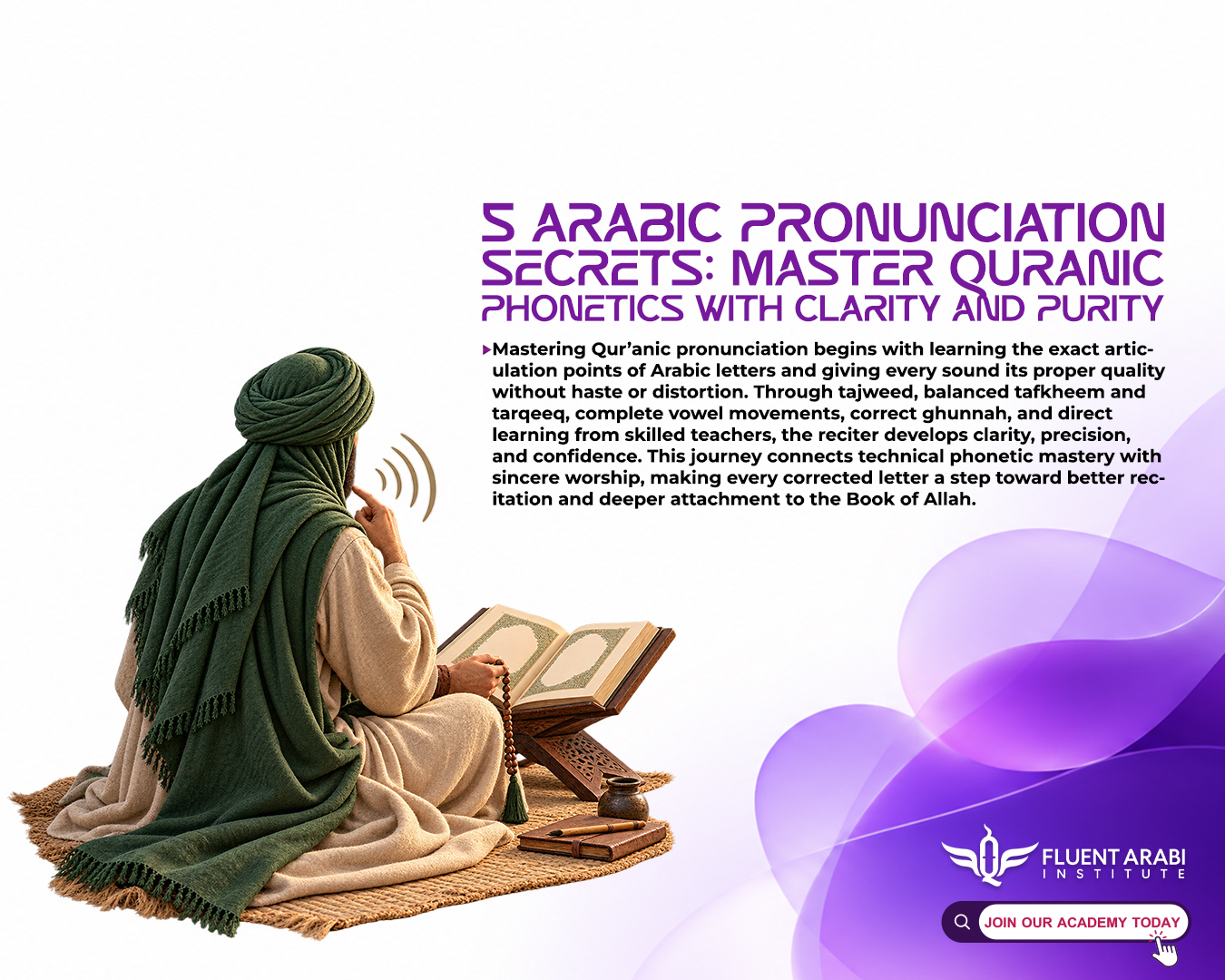
Mastering Arabic Pronunciation to read the Qur’an means reciting each letter of the Holy Qur’an correctly by highlighting its characteristics and points of articulation that distinguish it from others, while taking care to recite slowly and deliberately, without haste, and adhering to the correct rules of tajweed, in accordance with the words of Allah, the Exalted: (Or add to it, and recite the Qur’an with measured recitation) [Al-Muzzammil: 4].
The Arabic language is considered one of the richest and most precise languages in terms of its phonetic system, and this beauty and precision are further enhanced when reciting the Book of Allah. To achieve eloquent pronunciation and articulate the letters from their correct positions with clarity and purity, the Fluent Arabi Institute presents this comprehensive guide, which combines Islamic principles, historical roots, phonetic secrets, and direct practical applications.
Secrets of Arabic Pronunciation and Tajweed: How to Read the Quran Clearly
To master the art of reading the Quran and reciting it with clear Arabic pronunciation, the Fluent Arabi Institute is committed to teaching students five fundamental secrets that combine phonetic rules with practical application for each letter when you learn to read the Quran:
1. Mastering the Articulation Points of Letters and Distinguishing Between Similar Ones
The 28 Arabic letters are distributed across five main articulation points: the throat, the tongue, the lips, and the nasal cavity. Strict adherence to the correct articulation point prevents the overlap of sounds and distinguishes between similar ones:
- Pharyngeal letters: Distinguish between letters produced at the lowest and highest points of the throat to prevent sound distortion (such as clearly pronouncing “khā” and “ghayn” without confusing them with “hā” and “ayn” in words like (خَشِيَ) and (عَلِيمٌ).
- Vowel sounds: Articulating the three vowel sounds (alif, waw, and ya) clearly from the oral cavity without obstruction from the tongue (e.g., (قَالُوا) and (قِيلَ)).
- The side of the tongue and the letter “daad”: Pronounce the correct “daad” from the side edge of the tongue with the molars to prevent it from being confused with “dhaa” or “dal” (such as pronouncing (الضَّالِّينَ) with clear, precise articulation).
- The tip of the tongue and the alveolar letters: Carefully distinguishing between the vocal stresses of the letters “taa,” “dal,” and “taa’ ” when the tip of the tongue touches the upper alveolar ridge (e.g., (دَعَا) and (طَبَعَ)).
2. Balancing Tafkheem and Tarqeeq
Letters are classified by their thickness into letters that are always Tafkheem letters (خص ضغط قظ) and Tarqeeq letters, as well as others that vary between the two states, such as “ra’ (ر)” and the “lam (ل)” in the name of Allah. The key skill to learn to read the Quran correctly lies in distinguishing between similar sounds within a single word:
- Similar pairs: Distinguishing between emphatic (heavy) and softened (light) alveolar letters such as “dhaa’ ” and “dhal” (e.g., (ظَلَمُوا) and (ذَكَرُوا)), and “taa’ (ت)” and “taa’ (ط)” (e.g., (طَهَّرَ) and (تَرَكَ)), and distinguishing between the letters “saad (ص)” and “seen (س)” (e.g., (صَبَرَ) and (سَبَحَ)), and “qaaf” and “kaaf” (e.g., (قَدَرَ) and (كَتَبَ)).
- The “Lam” of the Divine Name of Allah: Making tafkheem after a fathah or dammah and softening it after a kasrah (e.g., emphasizing (شَاءَ اللَّهُ) and softening (بِسْمِ اللَّهِ)).
- Levels of Emphasis: Observing the five degrees of emphasis according to vowel movement (the highest being the open vowel followed by an alif, such as in (خَالِدِينَ), and the lowest being the broken vowel, such as in (قِيلَ)).
3. Mastering the Characteristics of Letters and Non-Moving Consonants
Each letter has specific characteristics, such as being Hams (air flows out while pronouncing) or Jahr (breath stops and voice emerges), and shiddah (sound is blocked, then released) or rakhawah (sound flows smoothly). Among the most important applications of mastering these characteristics while learning to read the Quran are:
- Giving consonants their due: Pronouncing letters with their soft or moderate sounds when they are silent, and not moving or vibrating them except in the letters of vibration (Qalqalah). Furthermore, controlling shiddah and rakhawah of consonants when they are silent in compound words prevents excessive vibration (such as pronouncing (أَرْسَلْنَا) and (الْحَمْدُ), pronouncing (يَكْتُبُونَ) without the quivering of the kaaf, and pronouncing (يَغْفِرُ) by giving the ghayn its softness).
- The qualities of sibilance and diffusion: Controlling the flow of sound in the letters saad, seen, and zay, and the spreading of sound in the mouth for the letter sheen (e.g., (يَشْتَرُونَ).
- Control of breath and sound: Distinguishing between voiced and unvoiced letters to ensure clarity in the articulation points of labial and lingual letters.
4. Completing the Movements and Avoiding Omission
Giving each movement its full duration prevents the “omission” or weakening of the movement, making the recitation clear and distinct:
- Opening the mouth clearly during the fathah.
- Closing the lips firmly during the dammah.
- Lowering the lower jaw during the kasrah.
5. The Art of Nasalization and Nasal Resonance
Ghunnah is a resonant sound produced from the nasal cavity (al-Khayshoom) that accompanies the letters Noon (ن) and Meem (م). Controlling its duration (two counts / Harakatain) gives the recitation a majestic tone and a sweet resonance, while taking into account making the Ghunnah velarized/heavy (Tafkheem) if followed by a heavy letter (e.g., (عَنْ صَلَاتِهِمْ) and light (Tarqeeq) if followed by a light letter (e.g., (مَنْ كَانَ).
Spiritual and Practical Tools to master Arabic Pronunciation and Read the Quran Effectively
To facilitate the learning journey and achieve mastery in Arabic pronunciation and reading the Quran effectively, the educational curricula at Fluent Arabi Institute divide learning tools into two main categories:
Spiritual (Heart-Based) Methods:
- Strong Determination: Possessing a sincere determination to overcome difficulties and ease the hardships of learning.
- Renewing One’s Intention and Seeking Guidance Through Supplication: Devoting one’s efforts sincerely to Allah, the Exalted, and praying two rak’ahs of supplication in the middle of the night to ask Allah to make learning easier.
- Patience and Perseverance: Being patient with the difficulties of mastering the Arabic pronunciation and reciting the Qur’an, correcting mistakes, and keeping in mind the great reward.
Practical Methods:
- Direct instruction and oral transmission: Learning recitation directly from skilled reciters, an essential prerequisite for ensuring the Qur’an is recited correctly.
- Relying on an annotated Qur’an (especially at the beginning of tajweed study): Using a Qur’an (preferably a large-format edition) with colored letters that help reinforce the application of tajweed rules.
- Listening to skilled reciters: Frequently listening to sheikhs known for their beautiful recitation and excellent performance, such as Sheikh al-Minshawi, Sheikh al-Husari, and Sheikh Muhammad Ayyub.
The Roots of Phonetics and Tajweed in Islamic Civilization
Muslim interest in phonetics began early, as every Muslim was expected to learn to read the Qur’an correctly. Allah Almighty says: (He created man, and taught him eloquent speech) [Ar-Rahman: 3-4], and says: (In a clear Arabic tongue) [Ash-Shu’ara: 195]. This prompted scholars to study the points of articulation and characteristics of letters with the utmost precision.
Muslim scholars relied on observation and experimentation in their phonetic research; they would place their hands on their throats and contemplate the points of articulation of the letters:
- Al-Khalil ibn Ahmad al-Farahidi: He established the science of prosody and authored the book “Al-‘Ayn”, in which he arranged the letters alphabetically according to their phonetic points of articulation, from the throat to the lips.
- Sibawayh: In his book Al-Kitab, he presented the first phonetic and grammatical encyclopedia detailing the points of articulation and characteristics of letters (Jahr, Hams, Shiddah, and Rakhawah) as well as rules such as Idgham and Ibdal.
- Ibn Jinni and Ibn Sina: In “The Secret of the Art of Grammar” and “The Causes of the Formation of Letters”, they addressed the physical anatomy of the speech organs and the influence of the environment on sound.
- Specialized Works: A succession of works on the science of tajweed emerged, such as al-Khaqani’s “Manzuma al-Ra’iyya”, Makki ibn Abi Talib’s “Al-Ri’aya”, Abu Amr al-Dani’s “Al-Tahdeed”, and Ibn al-Jazari’s “Al-Tamhid”.
FAQs
1- Is it possible to learn to recite the Holy Quran solely from books and apps?
Books and apps are excellent tools for theoretical learning and listening practice, but to learn to read the Quran accurately and correct the articulation of letters fundamentally requires direct instruction and oral practice under the guidance of a skilled sheikh or teacher, which is what we focus on at Fluent Arabi Institute.
2- How do I distinguish between the letters “daad” and “dhaa’ ” while reading?
Daad (ض): The “daad” (ض) is pronounced from the side edge of the tongue against the upper molars and is characterized by prolongation (Istitalah) (e.g., (الضَّالِّينَ).
Dhaa (ظ): In contrast, the “dhaa” (ظ) is pronounced from the tip of the tongue meeting the edges of the upper incisors, and phonetically, it is an emphatic interdental fricative (Rakhw/Majhoor) (e.g., (ظَلَمُوا).
3- What is the fastest way to eliminate vowel omissions when reading?
Practice reading slowly (tahqeeq), giving each sound its proper physical articulation: opening the mouth for the “fathah,” closing the lips for the “dammah,” and lowering the jaw for the “kasrah,” while recording your reading and reviewing it with a skilled instructor.
