
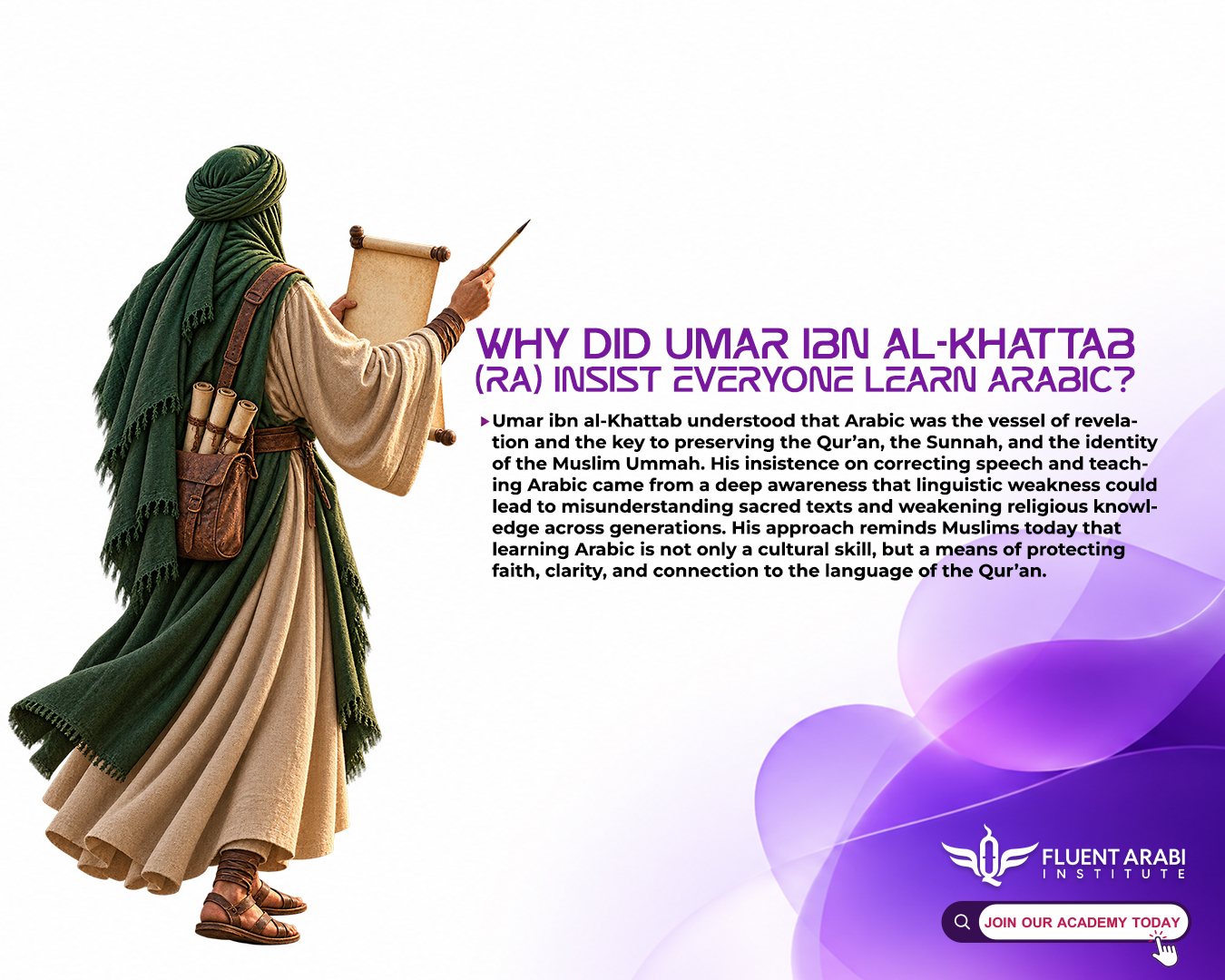
Throughout history, the Arabic language has not merely been a tool for daily communication or a means of conveying ideas; rather, it has been and continues to be the impregnable vessel that has preserved Islamic law and the identity of the Muslim nation. As the Islamic conquests expanded and Arabs mingled with non-Arabs, an urgent need arose to learn Arabic and protect the Arabic language from mispronunciation and foreign influences.
This gave rise to the timeless historical stance of the Commander of the Faithful, Umar ibn al-Khattab (may Allah be pleased with him), who, with his exceptional genius, realized that the integrity of the language is the first line of defense for preserving the Holy Quran and understanding the religion. In this article presented by the Fluent Arabi Institute, we explore the reasons behind Umar ibn al-Khattab (Al-Farooq) and the noble Companions’ insistence on learning and nurturing the Arabic language, and how this vision can inspire the contemporary generation to preserve its identity and language.
6 Core Pillars of Umar ibn al-khattab & the Companions’ Inspiring Approach to Preserving Arabic
1. The Language of the Quran and the Vessel of Faith: The Status and Supreme Virtue of the Arabic Language
The Arabic language derives its unique status from the fact that it is the language chosen by Allah, the Exalted, to reveal the Seal of His Revelations, making the learning and understanding of Arabic an integral part of worship and the study of Islamic law.
-
The Language of Revelation and the Quran: Allah has honored Arabic by making it the language of the Wise Remembrance, as understanding the rulings of religion and reflecting on its objectives are closely linked to mastering its meanings and rhetorical subtleties.
- A Fundamental Pillar of Religious Understanding: The importance of Arabic is evident in its role as the essential key to ijtihad (independent legal reasoning) and the derivation of legal rulings; no Muslim can truly comprehend the objectives of Islamic law and the Prophetic Sunnah without relying on the rules of this language.
- Educational and Behavioral Impact: It is narrated that the Commander of the Faithful, Umar ibn al-Khattab (may Allah be pleased with him) said, “Learn Arabic, for it is part of your religion,” explaining that learning the Arabic language strengthens intellect, rights the tongue, and safeguards the identity of the Muslim nation from dissolution and linguistic error.
- A Cradle of Civilization and Culture: Throughout history, the Arabic language has been distinguished by its exceptional capacity to absorb various sciences and fields of knowledge, and it has remained a stronghold for preserving the nation’s intellectual and cultural heritage.
2. The Influence of Umar ibn al-Khattab in Preserving the Arabic Language and Protecting It from Mispronunciation
The genius of the Commander of the Faithful, Umar ibn al-Khattab (may Allah be pleased with him), was evident in his keen realization that the integrity of the Arabic language is the protective fortress for understanding Islamic law, especially after the expansion of the Islamic state and the mixing of Arabs with non-Arabs.
A- The Link Between Language and Religion: Al-Farooq instilled in the Muslim community the conviction that learning and mastering the Arabic language was a religious duty. In his famous letter to Abu Musa al-Ash’ari, he wrote, “Study the Sunnah, and study the Arabic language.”
B- Combating Grammatical Errors and Linguistic Weakness: He did not tolerate mispronunciation in speech. It is reported that he once passed by a group of people who were shooting arrows and missing their targets; when he rebuked them, they replied with a grammatical error: “Inna qawmun muta‘allimin.” He turned away from them and uttered his immortal words: “By Allah, your mistakes in speech are more painful to me than your mistakes in archery.” They made a clear grammatical error by saying muta‘allimin instead of muta‘allimun. Correct Arabic grammar required the nominative form “Inna qawmun muta‘allimun” (Indeed, we are an educated people).
C- Establishing an Educational Approach to Preserving the Language: Umar (may Allah be pleased with him) urged that the youth be taught the rules of Arabic, Arabic poetry, and the memorization of traditional sayings, to protect the Arabic language from change and to ensure that Arabic remains the unifying language of the nation.
3. Controlling Speech and Avoiding Mispronunciation: The Guidance of Al-Farooq and the Companions in Preserving Speech
The Companions (may Allah be pleased with them) and the Commander of the Faithful, Umar ibn al-Khattab, focused on prohibiting idle talk and sternly warning against grammatical errors, emphasizing the necessity of learning the Arabic language correctly.
A- Prohibition Against Superfluous Speech: Al-Farooq and the Companions warned against speaking excessively without purpose, as it leads to mispronunciation and error, and its effects extend to the weakening of intellect and faith.
B- Warning Against Incorrect Speech and Immediate Correction: Al-Farooq took a firm stance against foreign speech and grammatical errors, considering the correction of speech to be a direct safeguard for the integrity of Islamic understanding and the identity of the ummah.
C- Guarding the Tongue Is the Foundation of Righteousness: The Righteous Predecessors linked the soundness of speech to righteous conduct, and they considered restraining the tongue from mispronunciation and idle talk to be the first step in safeguarding the mind and preserving meaning.
4. The Righteous Predecessors and Guarding the Tongue: Practical Approaches to Correcting Speech
The educational approach of the Companions was manifested in practical applications and real-life situations aimed at guarding, monitoring, and correcting speech:
- Self-Monitoring and Self-Accountability: The Companions were diligent in guarding their tongues and holding themselves accountable for every word, recognizing that the tongue is the true reflection of one’s mind and faith.
- Practical Correction of Errors: Al-Farooq (may Allah be pleased with him) was resolute in confronting grammatical errors, as he viewed the study of the Arabic language and the correction of speech as a duty no less important than correcting behavior.
- Establishing the Etiquette of Speech: The Righteous Predecessors made the integrity of speech and the mastery of the principles of speech a fundamental means of preserving the correct understanding of the noble texts.
5. The Companions’ Care in Preserving the Quran and the Language: Systematic Efforts to Preserve the Original Form
The Companions (may Allah be pleased with them) made historic and systematic efforts to preserve the Arabic language and protect the text of the Noble Quran.
- The Codification of the Quran and the Standardization of the Language: Their utmost care was manifested in compiling the Noble Quran and standardizing it according to the dialect of the Quraysh, so that it would remain the unified linguistic and legal reference for all Muslims.
- Protecting the Native Language from Foreign Influences: As the conquests expanded and non-Arabs converted to Islam, the Companions faced the danger of linguistic corruption. They addressed this by laying the foundations for preserving the authentic Arabic language and encouraging people to learn Arabic.
- The Link Between Linguistic Standardization and Understanding the Revelation: The Companions’ attention to the language was a legal necessity to ensure the soundness of reasoning and the proper understanding of the rulings of the Quran and Sunnah.
6. The Companions’ Educational Approach to Studying and Teaching Arabic to the Young
The first generation adopted an educational system to transmit the Arabic language and pass it down to new generations.
1- Studying Arabic as a Way of Life: The Companions were keen to make the study of Arabic grammar and vocabulary an integral part of their scholarly gatherings.
2- Language Education for Children: The Companions took care to encourage their children to learn Arabic and master it from an early age, correcting their speech to protect them from being influenced by foreign languages.
3- Preserving Identity and Passing on Knowledge: The Companions’ educational approach aimed to transmit the text of the Quran and the Prophetic sayings in their pure form, ensuring the continuity of correct Islamic jurisprudence across generations.
FAQs
1- Why did Umar ibn al-Khattab (may Allah be pleased with him) link the study of the Arabic language to religious understanding?
Because the Holy Quran and the Prophetic Sunnah were revealed in clear Arabic, and the objectives of Islamic rulings and legislation can only be accurately understood and deduced through learning the Arabic language and mastering its grammar and rhetorical subtleties.
2- How did the Companions (may Allah be pleased with them) address the threat of the spread of linguistic deviation following the conquests?
They addressed the issue of linguistic deviation by codifying the Holy Quran and standardizing it according to the dialect of the Quraysh, in addition to taking firm measures to correct speech through upbringing and education, and encouraging children and the younger generation to learn the Arabic language, Arabic poetry, and the rules of eloquent speech to preserve the Arabic language’s natural purity.
3- How does the Fluent Arabi Institute contribute to establishing the Companions’ approach to teaching Arabic?
The Fluent Arabi Institute provides comprehensive educational programs designed to facilitate the learning of the Arabic language for Muslim children, expatriates, and non-native speakers, and to help them master the Arabic language and the Holy Quran through modern methods that combine authenticity and effectiveness.
Conclusion
It is abundantly clear that the determination of the Commander of the Faithful, Umar ibn al-Khattab (may Allah be pleased with him), and his noble Companions to learn the Arabic language and correct speech was not merely a rhetorical concern or linguistic enthusiasm, but rather a conscious strategic vision to preserve the religion and protect the identity of the ummah. At the Fluent Arabi Institute, we follow this authentic approach and work to empower those who wish to learn and master the Arabic language according to the highest educational standards, so that we may serve as the bridge connecting the glorious past with the promising future.
