
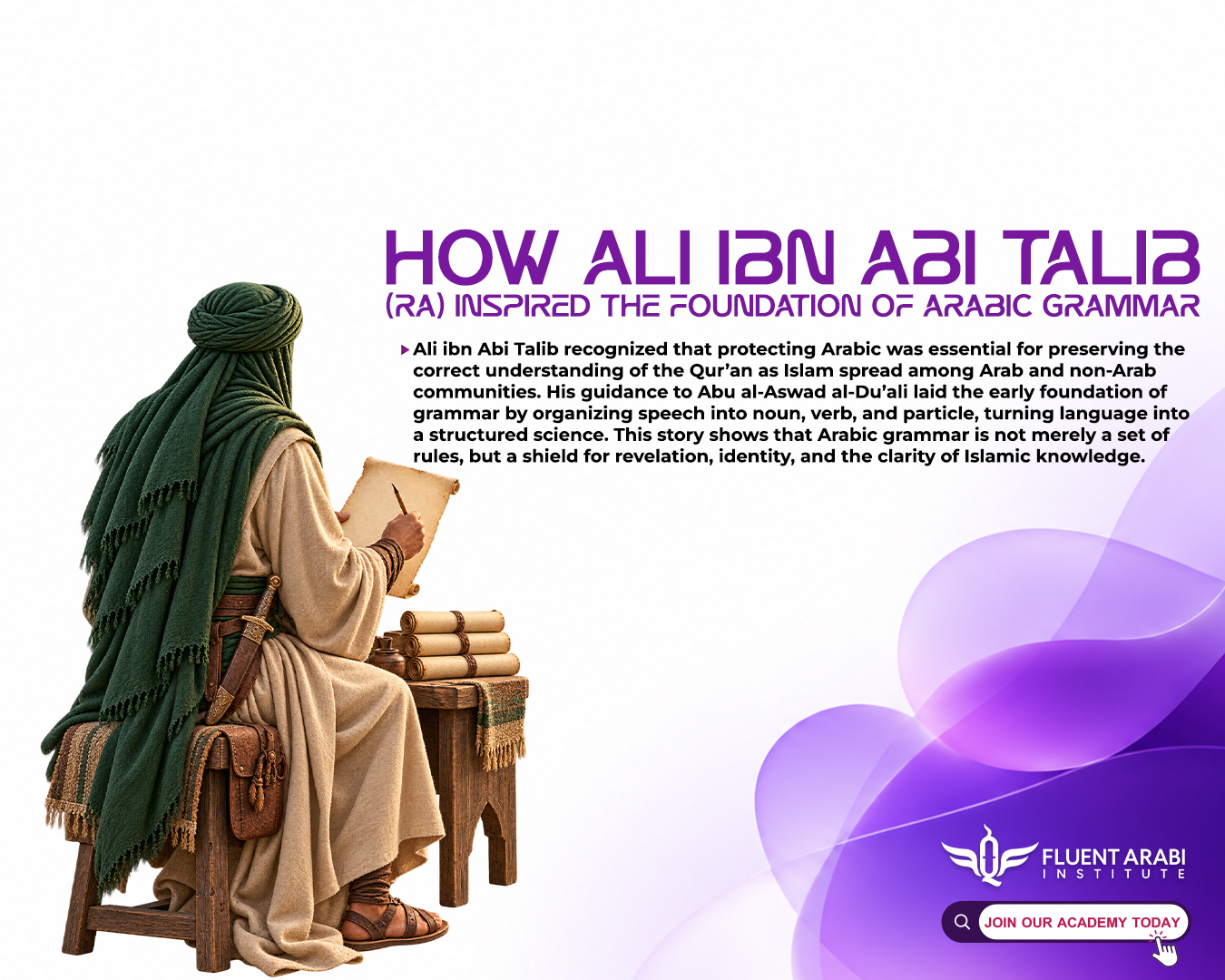
The Fluent Arabi Institute is dedicated to strengthening the Arabic language among students and Muslim communities in the West. Anyone who reflects on the history of linguistic scholarship will find that Ali ibn Abi Talib’s role in grammar served as the cornerstone and the initial nucleus that launched this great science, as his sound thinking and deep understanding of the Arabic language were evident in his establishment of the first guidelines to protect both religion and language.
The Origins of Arabic Grammar and Ali ibn Abi Talib’s Role in Grammar
First: The Roots of the Arabic Language and Manifestations of Eloquence Before Islam
1- The Status of the Quraysh and Their Language
a- The language of the Quraysh: It became the richest and most eloquent of the Arabic dialects as a result of tribes flocking to the markets of Mecca and neighboring regions (such as the markets of Ukaz, Majna, and Dhi al-Majaz) for trade and pilgrimage.
b- The purity of the Arabic language: The Holy Quran was revealed in clear Arabic, free from impurities; before Islam, Arabs rarely interacted with non-Arabs, and when they did, it was limited to commercial contexts.
2- Causes of the Emergence of “Lahn” and the Motivation for the Establishment of Grammar
a- Interaction between Arabs and non-Arabs: The expansion of Islamic conquests and the conversion of non-Arab peoples to Islam led to increased interaction and communication, resulting in the emergence of “lahn” (errors in grammatical inflection and word pronunciation).
b- Early caution against “Lahn”: The Prophet (PBUH) and many of the Companions (such as Umar ibn al-Khattab, Ali ibn Abi Talib, and Ibn Umar) rejected “lahn” and warned against it; some scholars, such as Ayyub al-Sakhtiyani, considered it a sin requiring repentance. This deep concern was later reflected in Ali ibn Abi Talib’s role in grammar to prevent this linguistic deviation.
c- The primary motivation for its establishment: Rulers and scholars feared that al-lahn and distortion might affect the text of the Holy Quran and the noble Prophetic Hadith; this was the main motivation for establishing rules to protect the Arabic language.
Second: Ali ibn Abi Talib’s Role in Grammar and the Establishment of the Tripartite Division of the Word
1- The Story of the Historic Scrap of Paper
a- Abu al-Aswad al-Du’ali: He entered the presence of the Commander of the Faithful, Ali ibn Abi Talib, may Allah be pleased with him, and found a scrap of paper in his hand. Ali said to him: “I have reflected on the speech of the Arabs and found it to have been corrupted by contact with these foreigners, so I wanted to establish something to which they may refer and upon which they may rely.”
b- The first classification of the parts of speech: The treatise written by ‘Ali, may Allah be pleased with him, contained the fundamental principle on which the leading linguists have unanimously agreed to this day: “All speech consists of three elements: a noun, a verb, and a particle that conveys meaning. A noun is what denotes the named entity; a verb is what is denoted by it; and a particle is what conveys meaning.”
2- Scholarly Transmission and Precedence
a. Consensus of Scholars and Linguists: The majority of scholars of hadith transmission and linguists (such as Abu al-Barakat al-Anbari and al-Qafti) have unanimously agreed that Ali ibn Abi Talib’s role in grammar is considered the first pioneering contribution.
b. Abu al-Aswad’s Own Testimony: Indeed, Abu al-Aswad al-Du’ali himself stated, when asked where he had acquired this knowledge, “I learned its fundamentals from Ali ibn Abi Talib.”
Third: The Saying “Follow This Approach” and Ali ibn Abi Talib’s Role in Grammar
Implementation of the Task of Codification
a. Expanding Grammatical Chapters: Abu al-Aswad took Ali’s (may Allah be pleased with him) guidance and expanded upon it, establishing chapters on the subject, object, and prepositions.
b. Innovating Diacritical Marks: He innovated the diacritical marks (fathah, dammah, kasrah, and tanwin) to prevent misreading of the Noble Quran.
Fourth: The Sequence and Development of the Science Across Generations
1- The Seed of Grammar and Its Expansion
a- Initial foundation: The initial foundation did not encompass every detail; rather, the rules established by the Commander of the Faithful served as the seed from which this science grew through the efforts of Abu al-Aswad’s students (such as Yahya ibn Ya’mar and Nasr ibn Asim).
b- The succession of scholars: Grammarians subsequently expanded the scope of Arabic, elaborated on the rules, and explained their rationale—from Maymun al-Aqran and Anbasa al-Mahri, through Abdullah ibn Abi Ishaq and Abu Amr ibn al-Ala, to al-Khalil ibn Ahmad al-Azdi, who paved the way.
FAQs
1- How did Ali ibn Abi Talib contribute to the foundation of Arabic grammar and the first classification of the language?
Ali ibn Abi Talib influenced Arabic linguistics by being the first to categorize and systematize Arabic speech into three main parts: noun, verb, and particle conveying meaning—in the famous manuscript he handed over to Abu al-Aswad al-Du’ali.
2- What is the linguistic meaning and historical significance of Ali ibn Abi Talib’s phrase “Follow this approach”?
It means “Intend this purpose and follow this path.” Ali ibn Abi Talib said this to Abu al-Aswad al-Du’ali to instruct him to expand on the principles of Arabic grammar he had written for him. From this historic guidance, the discipline was named “the science of grammar.”
3- How do students at the Fluent Arabi Institute benefit from studying Ali ibn Abi Talib’s role in the origins of Arabic grammar?
They benefit by understanding the meticulous methodology pioneered by Ali ibn Abi Talib and early scholars to preserve the Arabic language, and they come to appreciate the importance of grammar as an essential tool for understanding the Holy Quran and the noble Prophetic Hadith with accuracy and integrity.
Conclusion
This historical account clearly shows that Ali ibn Abi Talib’s role in grammar wasn’t just a passing idea; it came from a deep, thoughtful vision aimed at protecting our sacred values and our language.
By keeping these stories alive, the Fluent Arabi Institute truly hopes to inspire students and researchers to realize how important it is to master Arabic, holding onto it proudly as the language of our identity and the key to truly understanding the Holy Quran.
Ready to dive deeper into the rules of Arabic and connect with the Quran more clearly? Explore our structured grammar courses at the Fluent Arabi Institute today and learn right alongside our expert native instructors!
